

TP MINDS London, June 2025
Moderator: Joris Nijhuis (Taxtimbre)
Panelists: Anastasiia Matviiets (Under Armour), Elias Thomas (Spotify), Jere Tormanen (Bata), Roberto Lai (Kindred Group), Jörg Hanken (Optravis)
To kick it off, here is the polling result of 78 participants:
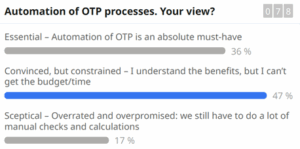
I’m glad to see that 83% believe that OTP automation makes absolute sense, while 47% cannot start due to budget and time constraints. See the reply below to the question of how to get a budget (#2 and #3).
I would like to share my views on the following 11 questions that the participants raised during our panel session, “Corporate Approaches to Operational Transfer Pricing.”
- Any recommendations for fully automating TP set up for SKUs, particularly at budget time when all TPs globally might be reviewed and updated?
Some multinationals calculate all their TPs per SKU during the budget phase and throughout the year using different technologies. Excel is the most common solution, but the process is manual. Some software solutions exist that are ERP-integrated or TP-specific, such as the Optravis TP Management Tool, which can calculate all TP’s per SKU globally for all trading partner relationships, considering any TP method, as well as controlling and anti-dumping rules.
- Do you have any recommendation of how to build the business case to persuade the senior management to implement OTP software?
According to our experience, creating a business case is quite common when making a software investment. Typically, we estimate potential tax savings because target margins can be met more precisely with powerful, smart OTP software, and double taxation can be avoided. Depending on the industry and the volume of transactions crossing customs borders, customs savings can exceed tax savings, especially due to current geopolitical developments. Furthermore, an automated OTP process requires significantly fewer FTEs at headquarters, in shared service centers, or locally. However, multinationals rarely know how many hours or days are spent on the TP process globally because several departments and people are often only minimally involved. We recommend analysing the time spent on the entire TP lifecycle, including budgeting, price setting, margin monitoring, year-end adjustments, TP documentation, and TP/tax audit defense years later. We know of companies that reduced their TP resources from 20 to three employees, who can now concentrate on other, more valuable finance, controlling, and accounting tasks. Often, saving one to three FTEs globally finances the annual software licenses. Another good argument for the business case could be reducing process time during budgeting and quarterly or annual closings by a few days, which alleviates pressure. Year-end adjustments are often the last journal entries that have to be booked. Finally, the likelihood of getting budget approval for an OTP project is highest if there has been a significant tax compliance violation or a major TP adjustment triggered by a tax audit. In most countries, managing directors are personally liable for tax compliance violations, such as tax fraud.
- How does one “sell/ position“ benefits of OTP automation to budget approvers when the typical response is how many staff can we reduce? Wait for an audit?
See reply #2 above. Sometimes, waiting for a tax audit and receiving a significant OTP adjustment can speed up the decision-making process. However, we highly recommend fixing the roof while the sun is shining. Such TP adjustments can be expensive, considering tax, double taxation, interest, penalties, and internal and external costs.
4. What would be the suggested course of action you would recommend drafting a CbCR for the first time?
a) Start by creating a mapping of the account line items to the CbCR data fields. If the chart of accounts are not harmonized in your group, then we need a mapping table per chart of account. At the end we create a table in a standardized format which contains all the data required for CbCR table 1.
b) Check whether you receive the data centrally or locally. Usually, all CbCR fields except for full-time equivalents (FTE) and tax cash can be derived from the profit and loss (P&L) statement and the balance sheet. Many multinationals export most of the data from a central ERP, BW, BI, or consolidation system, and collect the other data (e.g., FTE, tax cash, and table 2 main activities) via a questionnaire sent to local employees.
c) Add up the data of the legal entities per country. Do not consolidate. The treatment of permanent establishments is tricky.
d) Analyze CbCR data and the risk KPIs provided by the OECD. Manage outliers.
e) Convert the data into XML according to the local schema of the ultimate parent company.
f) File with the local federal fiscal office of the ultimate parent company.
- If a big corporate group wants to now centralise TP documentation, how would you go about implementing OTP, when various ERPs to be aligned to get right data?
There are two scenarios:
a) Best practice (currently a growing minority of multinationals): The company has implemented software that calculates transfer prices for goods, services, and royalties. No one needs to perform a frustrating and inefficient global or local search to find IC transactions or segmented P&Ls. Your central software is the single source of truth. All really important information you need in your TP documentation is available in this software. Users can easily export relevant data from this central software, which is the most efficient way to obtain data for TP documentation reports. Many multinationals are doing this for about 10 years. Powerful TP tools, such as the Optravis TP Management Tool, can handle data from different ERP systems. Currently, the most complex client uses 36 different ERP systems, and it works. Start a data-focused proof of concept (PoC) to test and prove whether your data is fit for TP automation. Optravis has performed more than 60 POCs, 90% of which were successful. So, please don’t assume that your data isn’t good enough!
b) Practice (currently the shrinking majority of multinationals): If a multinational has not implemented the aforementioned central OTP software, a central team usually organizes the collection of relevant data from local colleagues. This often involves a very manual process where Excel spreadsheets are circulated via email. Then, the central team often tries to reconcile the IC transaction volumes received from local providers and receivers. These numbers usually do not match by many reasons. This is a frustrating exercise that adds no value and is no fun. To save time, ask yourself why you are doing the reconciliation exercise in the first place. You could also decide to only collect IC transaction volumes from the invoice provider and mirror them to the recipients. Some multinationals start with data from the consolidation system. However, we have found that distinguishing non-goods transactions is often not possible at that level. Companies usually use standard software, like Alteryx, to import data for different transactions from different sources, standardize it, and then create an IC transaction matrix, for example. There are plenty of TP documentation tools on the market that significantly increase the efficiency of preparing the master and local files, including translations. However, most of them assume that you have already collected or exported the necessary data.
- OTP is a journey or ethos rather than just technology. How do you manage the build with future flexibility in mind? How do you bring the business along for the ride?
Correct. OTP is not just a technological topic. It’s all about people, processes, and data. Without proper and timely stakeholder management, an OTP project will not succeed. Tax/TP, controlling/accounting, and IT are mostly involved. Typically, they all report to the CFO. Therefore, the CFO (group CFO plus division/BU CFOs) must promote and communicate this project. For future flexibility: You should opt for flexible software that can be configured by you so that you are not dependent on IT or external consultants. Please be aware that as your business operations and supply chains change, the configurations in your OTP software and your OTP process must be updated (see #7).
- We all understand the benefits of OTP. Have you experienced any issues or pitfalls after implementing OTP? Does it work as a perfect solution?
According to our experience, OTP is more of a journey than a one-time project. This means that the OTP process and software configurations must be adapted to reflect changes in supply chains, transaction flows, and the integration of new entities, among other things. Furthermore, in the case of R- or TNMM, the ex-ante pricing process relies heavily on the quality of the forecast. For very dynamic businesses, it is difficult to fall within the IQR with an ex-ante pricing approach. Year-end adjustments are required. Forecasting is an interesting topic in its own right. Usually, forecasts only reflect the top line, and sometimes not even at the entity level, but rather at the business unit or regional level. Furthermore, official forecasts are often used for business management and motivation purposes. These two facts are not helpful for calculating TP, which should lead to arm’s length EBIT margins. Therefore, ten years ago, we decided that we needed our own forecasting engine that forecasts quantities, third-party sales prices, overhead costs, etc., per legal entity. This engine uses several state-of-the-art forecasting strategies that can be customized per client. Therefore, I would say that the “perfect” solution only exists as long as the business model, supply chains, etc., do not change.
- What could be the best approach to integrate a newly acquired group in your current TP structure having diversified business and data quality issues?
Over the last ten years, all of our clients have acquired other groups and integrated them into the Optravis TP Management Tool. Generally, we perform a data-focused proof of concept (PoC) project to test the data structure and quality of the newly acquired group. As mentioned above, over 90% of the 60+ PoC projects have been successful (see #5a above). Therefore, in 90% of cases, we cannot confirm that data quality issues hinder the implementation of an OTP process and software.
- Data source risk is high. How tax authorities can estimate this risk?
I am sorry, but I do not understand this question. Please feel free to contact me.
- Are certain ERP systems better at enabling OTP? Or is it all about the set-up, whichever ERP is used?
We don’t believe there are ERP systems that significantly outperform others in enabling OTP. No ERP system was developed to perfectly fulfill tax or TP requirements. We have the impression that ERP providers focus on clean core processes and standards. Over the last years, they avoid niche processes, industry specifics, and customer specifics. This is why a lot of customization is still required, including the implementation of additional specific software, which is being performed by many IT implementation partners. For example: Many multinationals have found it helpful to use TP-specific standard software instead of squeezing in a lot of TP-specific code directly into the ERP system when migrating from SAP R3 to SAP4/HANA. This is because the migration was quicker and less complex, as only the data import and export interfaces had to be adjusted. In answer to the question, we believe that the setup of the ERP system and the core processes increases or decreases the likelihood of achieving a “perfect” OTP process. Ideally, one global ERP template would be implemented, and the chart of accounts would include one specific revenue account per I/C transaction group. There would also be one central data lake, and the master data would be well-maintained. The most important point and biggest misunderstanding is that some heads of tax or heads of transfer pricing believe they cannot start with OTP unless the aforementioned “perfect” state is reached. This is clearly an incorrect assumption! None of our Optravis customers have this “perfect state”! Master data will never be perfectly maintained. It’s about the power of OTP software to address such inefficiencies by smartly importing and cleaning raw data (e.g., mapping, replacing, and connecting). This is precisely what the Optravis OTP Management Tool has been doing for over 10 years.
- For those on the panel that have succeeded in implementing an automated process, are there moments when you miss the simple spreadsheet? If so, what are they?
Even when using TP-specific standard software, some users still like to export tables from the tool to do analysis and reporting in Excel, which is perfectly fine 😊
We hope you found some of the questions and answers helpful!
Please feel free to reach out to me if you’re interested in starting an exciting conversation about automating the OTP process.
If you would like to speak with multinationals that have been using OTP automation software for a while, we would be happy to connect you with them.