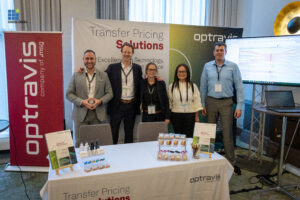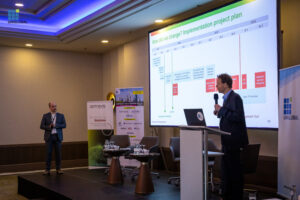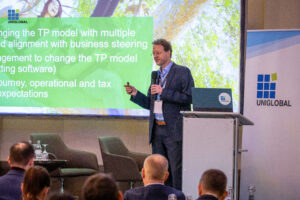
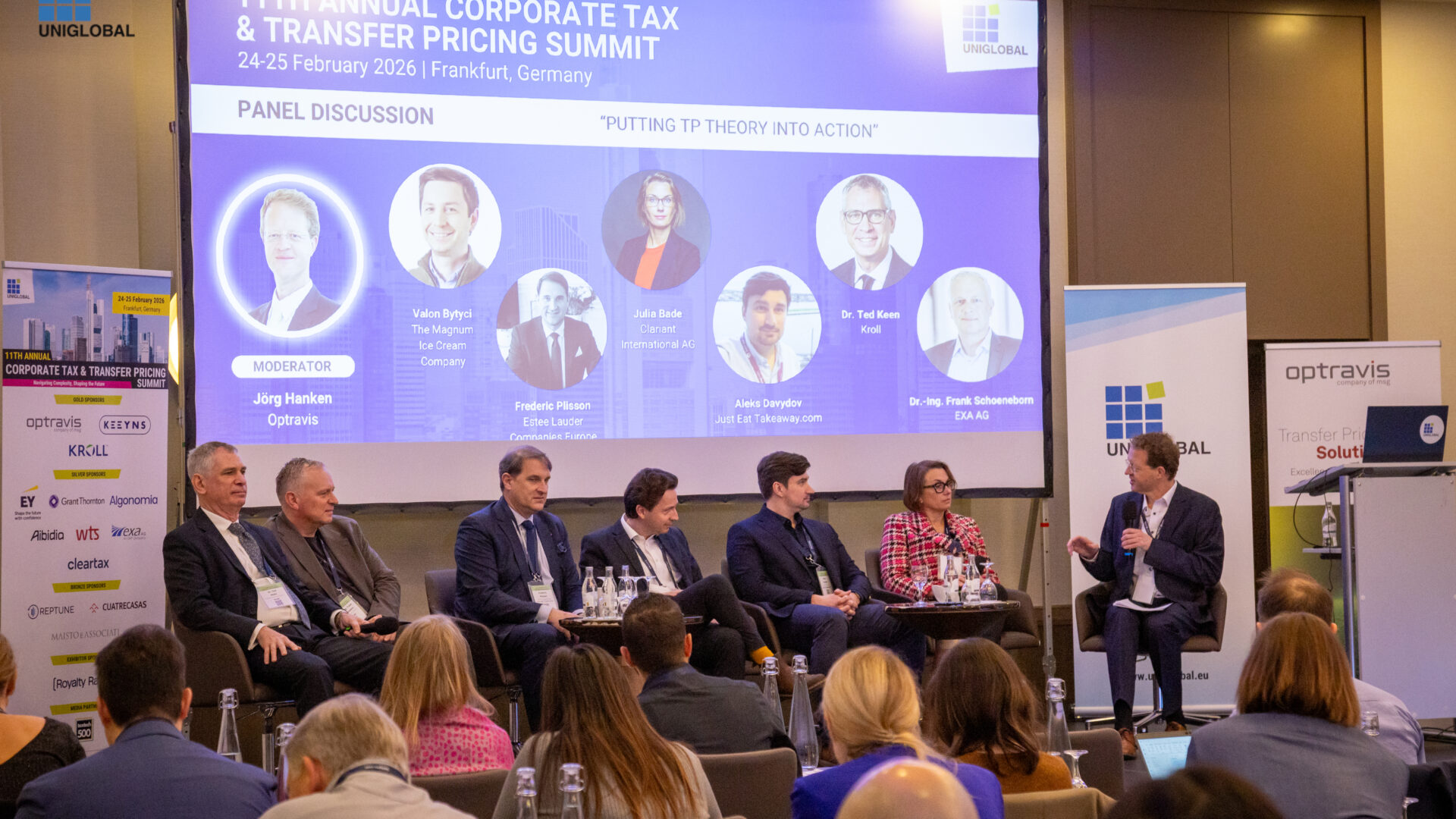
This is a summary of the Operational Transfer Pricing key takeaways from the Uniglobal Tax/TP conference on 24/25 February.
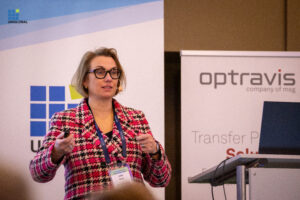
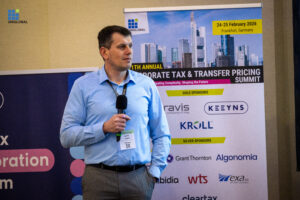
Many thanks to the colleagues Alban Scheider (Lohmann & Rauscher), Frederic Plisson (Estée Lauder), Julia Bade (Clariant), Valon Bytyci (Just Eat Takeaway), Aleksandr Davydov (Magnum Icecream), Dr Frank Schoeneborn (exa) and Ted Keen (Kroll), Jörg Hanken , André Jaekel, Jonas Ricardo Morath and Céline Stingelin who joined us and contributed valuable insights, helping to make this event a great success.
- If you want to automate your TP processes, carefully analyse whether the ‘make’ or ‘buy’ option is superior in terms of implementation time, budget, functionality, user-friendliness, service and IT strategy. Based on discussions with in-house experts, it seems that ‘buy’ is implemented faster and more cheaply, and offers better functionality and service. ‘Make’ is sometimes preferred by IT, but such projects can take years and have an unpredictable outcome, resulting in the worst ROI.
- AI is an important new technology, but it does not magically solve all tax/TP challenges. In TP, the following AI use cases make sense: comparing local files for consistency and conformity with local TP documentation regulations; writing industry analyses for local files; supporting and accelerating technical research; identifying outliers and patterns; and supporting forecasting. The following AI use cases do not make sense: writing all local files (who wants to review all this text?), calculating transfer prices (this is straightforward mathematics) and setting up segmented P&L (globally consistent and well-thought-through formulas are required). It is better to use one centrally approved text that is used in local files without any changes.
- From a CFO perspective, the best transfer pricing (TP) strategy is to have separate management and legal books in order to achieve the best business steering results (maximum group EBIT) and full tax compliance. For the past 10 years, there has been a strong trend for multinationals to use second condition or price splitting models to calculate and report controlling TP’s and tax TP’s.
- Once the books are separated, standard software for P&L segmentation, forecasting and TP calculation can be implemented quickly and within the promised budget. For our most recent implementation with Lohmann & Rauscher, we completed the proof of concept project within two months and the implementation project within six months.
- Some heads of tax have shared the following observations: (1) Customs seems to be more important and impactful than income taxes. (2) Tax resources are so limited that there is neither the time nor the inclination to optimise or plan ETR; meeting the ever-increasing tax compliance requirements is consuming all available resources. (3) Tax audits are becoming more aggressive, subjective and less principle-based. For example, they still request single evidence for low-value services, which goes against the OECD guidelines. (4) There are ongoing conflicts, discussions and complaints between business/controlling and tax if local MDs receive their bonus based on local legal entity EBIT (one price system).
- More and more multinationals are replacing Excel spreadsheets and manual processes with standard software for the intercompany service charge process. Integration with legacy systems is possible and improves accuracy, consistency and speed. A strong, centrally managed service charge tool significantly supports the calculation, documentation and defence of service charges.
Don’t assume that your data is too poor for transfer pricing automation! In 90% of our proof of concept projects, it turned out that the data was good enough. We are data experts! Trust us! Start a PoC project with us and you will see!
Please note that we have retained all of our customers since our foundation 12 years ago! We deliver what we promise: on budget, on time, and on quality! 😃
Please book a live demo for our TP Management Tool, the Service Charge Tool or the License Tool here.